
Bench Warrants in Fairfield County
A bench warrant is court process tied to a case or required appearance. Fairfield Magistrate Court says failure to appear or post bond may lead to a bench warrant. The word “may” matters: the South Carolina bench-warrant memorandum describes options after a first missed summary-court setting, including rescheduling.
A missed notice can also reflect a docket change or clerical issue. Check with the court before assuming the result. A bench warrant is distinct from a new arrest warrant, which concerns probable cause for an offense.
A Missed Fairfield Date Is Not Automatic
Fairfield's Magistrate page says an FTA or failure to post bond may cause a bench warrant. The Judicial Branch bench-warrant memorandum says a court may reschedule after a first missed summary setting and describes warrant use as discretionary in that context.
If the person missed a date, ask the court to review the specific file. Do not assume an automatic warrant, and do not treat a later roster entry as confirmation that one was never issued.
Note: A summons, roster, and bench-warrant order are different records; ask which one appears in the court file.
How a Fairfield County Bench Warrant Is Issued
The judge handling the case decides what to do after a required appearance is missed. SCCA/523 is the South Carolina bench-warrant form identified for failure to appear. It records the court and case, the FTA finding, the custody command, and the officer's return.
For General Sessions, Rule 3 addresses transmission of warrants to the Clerk, while Rule 30 addresses sheriff efforts to serve and report bench warrants. Neither rule creates a public online status field.
Fairfield Bench Warrants Move From Court to Sheriff
The SCCA/523 form helps explain the handoff: the court issues the order, and an officer records whether service occurred. It includes fields for court, case, judge, service location, and return information. Sensitive personal descriptors appear on the official form for official use and do not belong in a public guide.
Fairfield Magistrate Court's local page is shown below because it explains the county summary-court route, including FTA and bond procedures.
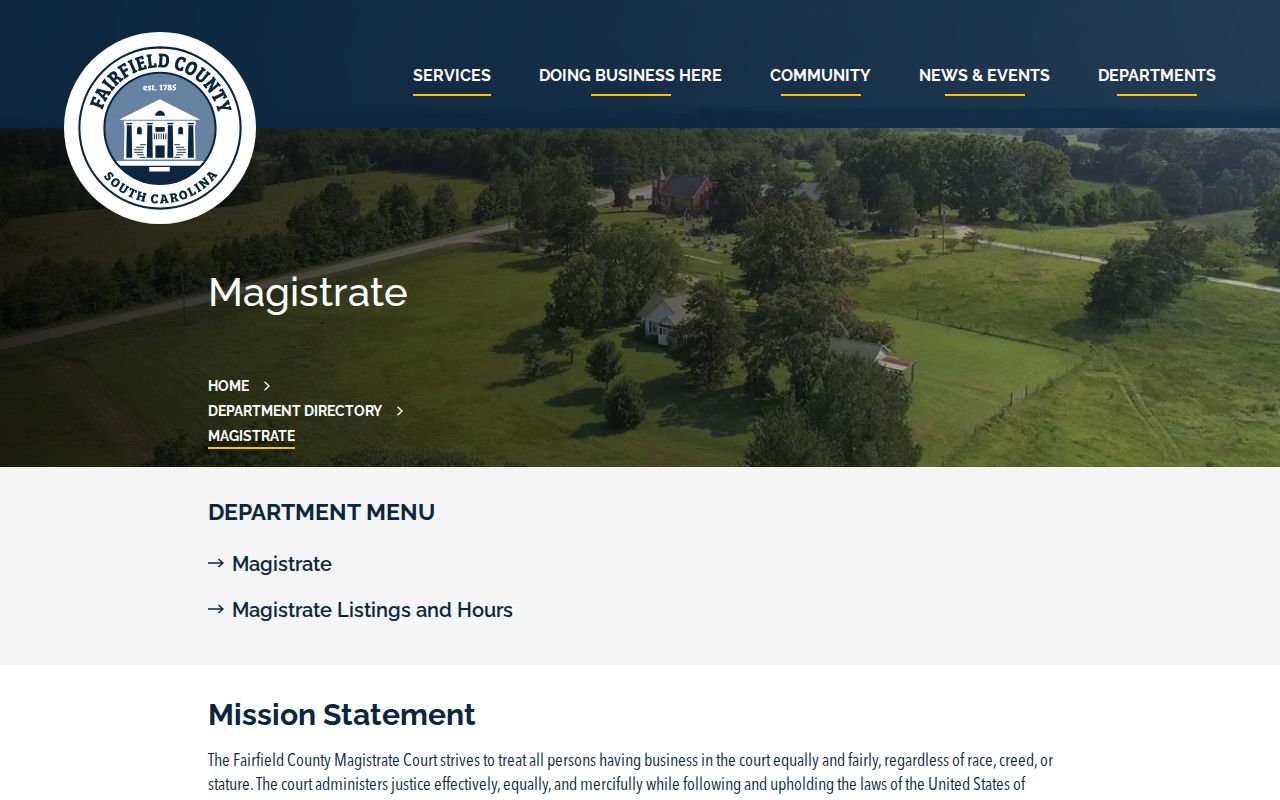
The page is a court-contact source, not a public warrant list.
View the official SCCA/523 form without copying a private person's completed form.
Bench Warrant vs Arrest Warrant
A bench warrant follows a court event, such as a missed setting or noncompliance. An arrest warrant follows probable-cause review tied to an alleged offense. Both can authorize custody, but they start in different parts of a case. See Fairfield County arrest warrants for the investigative process.
| Feature | Bench Warrant | Arrest Warrant |
|---|---|---|
| Trigger | Missed appearance or court requirement | Probable cause after investigation |
| Who Issues It | Judge handling the pending case | Authorized judge or magistrate |
| Underlying Case | Existing case or court setting | Criminal investigation or charge |
| Next step | Ask issuing court about appearance or recall | Confirm through court or counsel |
Fairfield Court Rosters Are Not Warrants
A roster can help identify a court term or upcoming setting. It does not show a complete warrant inventory, and an appearance entry does not establish that a bench warrant is active or recalled. The Clerk or issuing judge's office must confirm the current record.
For General Sessions, the Public Index and Court Rosters are separate tools. For a Magistrate or municipal case, call that court directly with the citation or case number.
How to Resolve a Bench Warrant
Begin by identifying the issuing court and asking what procedure applies. Depending on the case, a lawyer may discuss a motion to recall or quash, an appearance, a new setting, bond, or another court order. Fairfield does not publish one public recall form for every court level.
- Use the case number to identify whether the matter is General Sessions, Magistrate, or municipal.
- Ask counsel or the issuing court whether an appearance, motion, payment, or bond step applies.
- Confirm the location, hours, and custody procedure before traveling.
- After action, ask the court which term it uses for the outcome, such as recalled, quashed, or served.
Caution: Do not rely on a docket screen alone; discuss a safe appearance plan with counsel when a warrant or custody question may be involved.
Fairfield Bond Schedules Need Confirmation
The Detention Center page lists daily bond hearings with different times for Winnsboro Public Safety arrests and other law-enforcement charges. Winnsboro Municipal Court separately lists its own daily bond windows. These are operational schedules, not a promise of release or a universal bond amount.
The county's detention contact and directions pages list different street addresses. Call the facility before traveling and ask which entrance, office, and time apply to the specific case.
Note: Confirm the building and schedule by phone because official detention pages show conflicting street addresses.
Fairfield Bench Records Use Specific Terms
Read the court's wording closely. A case may show a missed setting, a warrant order, a service return, or a later court action. Those entries describe different points in the process, and one does not automatically prove the next happened.
- FTA
- Failure to appear at a required court setting.
- Recall
- A court's action withdrawing a process under its procedure.
- Quash
- A court order setting aside process.
- Return
- An officer's report of service or attempted service.
Ask the Clerk, Magistrate, or town court which event is current and what office can confirm it.
Which Fairfield County Court Issued It
A General Sessions bench warrant routes through the Clerk and the circuit court. A summary matter belongs to the relevant Magistrate Court. A town citation may be held by Winnsboro or Ridgeway Municipal Court. The sheriff serves process, but the issuing court controls the case and any recall procedure.
Use the Fairfield Clerk's court record information or the state municipal court directory to identify the office, then confirm its current process.